Professional website: what should it have in 2026?
In 2026, a professional website needs to load quickly on mobile, explain the offer in seconds, provide simple ways to get in touch, respect privacy and security, and be looked after once it goes live.
 Sylvain
Mobile first, everything else second
Most visits to business websites in the UK now come from a phone, often over an unstable connection and with little patience to spare. Designing for small screens first forces you to decide what really matters: a clear proposition, an accessible contact button and text that can be read without zooming. A site that only looks good on a large screen is failing the majority of its visitors.
Real speed, not just a score
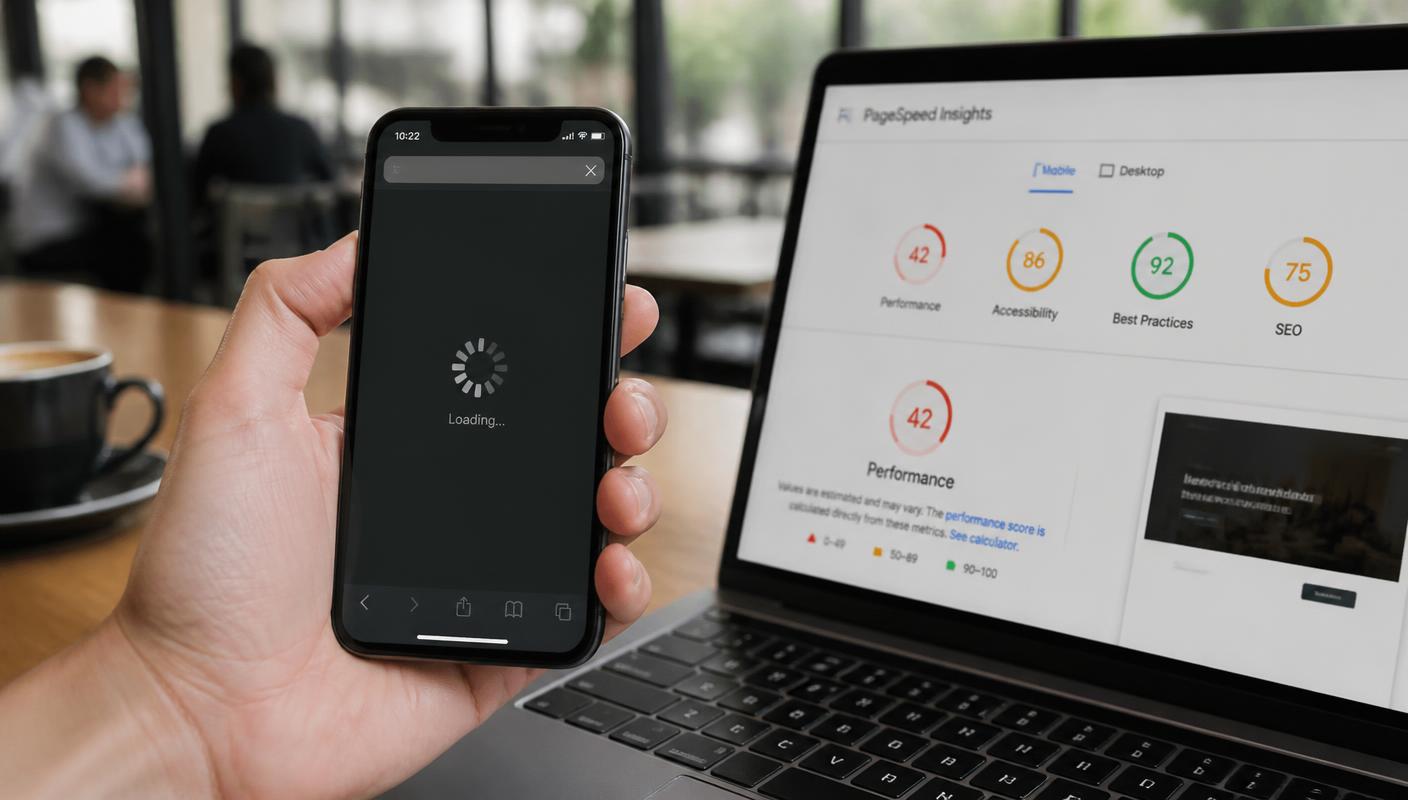
Heavy images, dozens of external scripts and weak hosting are the usual causes of slowness. The goal is not a nice number in some testing tool, it is that the page becomes usable quickly on an ordinary mobile network. This is covered in more depth in a slow site and its impact on sales.
A value proposition that is clear in seconds
Visitors should immediately understand what the business does, for whom, where and what the next step is. Vague talk of innovative solutions says nothing. The service name, the audience, the geographic area and a concrete call to action are worth far more than any slogan.
A structure built for conversion
- One main goal per page, with a visible call to action that does not require excessive scrolling.
- Short forms, with only the fields the team actually uses.
- Alternative ways to get in touch, such as phone, email or messaging, because not everyone wants to fill in a form.
- Proof close to the decision point: work examples, genuine reviews and answers to the most common objections.
More detail on this point in how to get more clients through your website.
Simple navigation
Menus with dozens of entries bury what actually matters. A clear structure, with services grouped logically and internal links within the content, helps both people and search engines understand the site's hierarchy.
Trust
Trust is built through verifiable detail: business identification, address or service area, real contact details, accessible legal information, genuine photography and up-to-date content. A site with no human signal at all loses out to a competitor that shows who is on the other side.
Accessibility
Sufficient contrast, alt text on images, navigation that works with a keyboard alone, a visible focus state and correctly labelled form fields. Beyond being the right thing to do for people with visual or motor limitations, it improves usability for everyone and helps automated tools read the pages correctly.
SEO from day one
Unique titles and descriptions, a single H1 per page, clean URLs, a sitemap, structured data where relevant and a correct language strategy if the site is multilingual. Doing this during the build costs little. Fixing it afterwards always costs more, as we explain in what SEO is.
Analytics and measurement
Without data there is no improvement. At the very least, you should know how many visits arrive, where they come from, which pages generate enquiries and where people drop off. This needs to be set up at launch, not months later.
Privacy and security
Proper cookie consent, a privacy policy that reflects what the site actually does, forms protected against abuse, a valid certificate, regular updates and tested backups. A compromised business website costs far more to recover than it would have cost to prevent.
Quick checklist
| Area | Check question |
|---|---|
| Mobile | Is the homepage usable without zooming or scrolling sideways? |
| Speed | Does the main content appear quickly on an ordinary mobile network? |
| Message | Does a stranger understand what we do within five seconds? |
| Contact | Is there more than one simple way to reach us? |
| Measurement | Do we know which pages generate enquiries? |
| Security | Are there regular updates and backups in place? |
About the author
Sylvain
Founder, WebCastelo
Sylvain is the founder of WebCastelo and works every day on websites, online stores, booking systems, custom software, SEO and digital advertising for companies in Portugal and the rest of Europe. He writes about what he sees in real projects: what works, what costs money without a return and what is worth doing first.