
Google Ads or SEO: which is best for your business?
Google Ads buys immediate visibility and stops the moment the budget runs out. SEO builds lasting visibility but takes time. The right choice depends on urgency, available budget, competition and customer value.
 Sylvain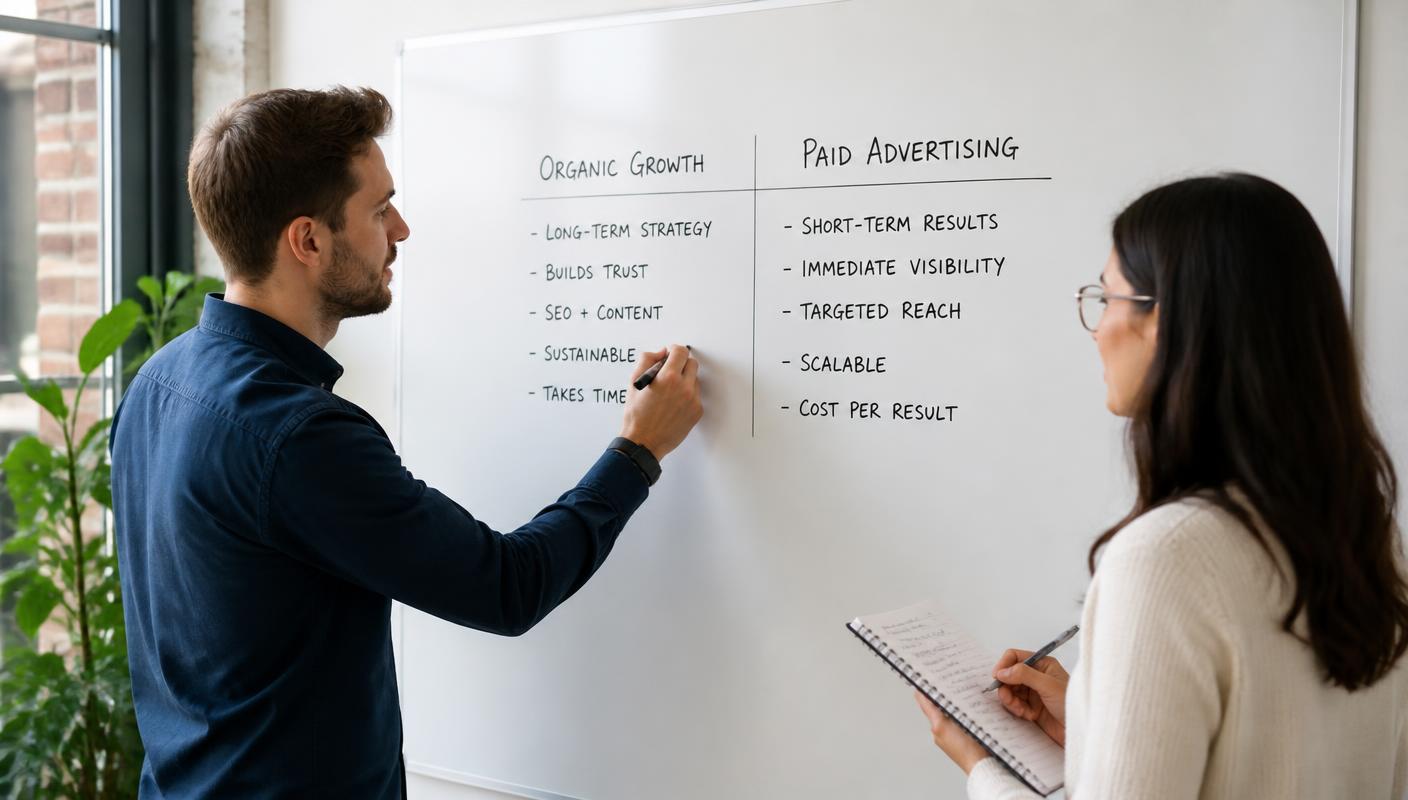
Two tools, two different jobs
Paid campaigns put your business in front of people today, for the terms you choose, for as long as the budget lasts. Organic work improves your chances of showing up without paying per click, but it takes time to mature. If you're not yet clear on how each one works, start with what SEO is and what SEA is.
A direct comparison
| Criterion | Google Ads | SEO |
|---|---|---|
| Speed | Results within days | Results within months |
| Predictability | High, spend is controlled | Medium, depends on the market |
| Marginal cost | Every extra click costs money | Doesn't rise with each visit |
| Duration | Stops when the budget stops | Continues with upkeep |
| Message control | Full, you write the ad copy | Partial, depends on the result shown |
| Market testing | Excellent for validating demand | Slow for testing hypotheses |
| Competitive barrier | Low, anyone can bid | High once well established |
Decision criteria
How quickly you need results
If you need enquiries this month, for a launch, a busy season or a diary that needs filling, advertising is the realistic route. SEO doesn't speed up with money in the same way.
Budget
With a small, ongoing budget, SEO investment tends to build value over time. With a larger one-off budget, a well-targeted campaign pays off straight away. The worst outcome is splitting a small budget across both channels and never reaching critical mass in either.
Competition
In highly contested sectors, cost per click can be steep and the top organic positions are usually held by long-established, strong sites. In those cases it's often worth starting with specific niches and local terms rather than going after generic ones.
Customer value
The higher a customer's long-term value, the more advertising spend it can support. Low-value, one-off services have less room for a high cost per enquiry and gain more from organic traffic.
Existing demand
If nobody is searching for what you sell, neither channel solves the problem on its own. In that case you need to create demand through other channels and use search to capture those already comparing options.
Time horizon
Short-term goals call for campaigns. Two or three-year goals call for a solid organic foundation, otherwise the business stays permanently dependent on the ad budget.
What both channels require
- Clear, fast landing pages with an obvious call to action.
- Accurate conversion tracking, so you know what actually drives business.
- Honest information about prices, timelines and conditions, which cuts down on low-quality enquiries.
- The ability to respond quickly to the enquiries that come in.
Without this, any investment in visibility performs worse. We cover this in more depth in how to get more customers through your website.
Frequently asked questions
Can I stop advertising once SEO starts working?
Many businesses gradually scale back on terms where they already rank well, while keeping campaigns running for the most competitive or seasonal terms.
Does running ads improve organic rankings?
Not directly. What it does improve is your understanding of which terms and messages convert, and that insight helps guide the organic work.
About the author
Sylvain
Founder, WebCastelo
Sylvain is the founder of WebCastelo and works every day on websites, online stores, booking systems, custom software, SEO and digital advertising for companies in Portugal and the rest of Europe. He writes about what he sees in real projects: what works, what costs money without a return and what is worth doing first.