From website to lead machine: turning visits into customers
A website produces business when technical foundation, clear positioning, relevant visibility and an obvious conversion path work together. More traffic without that system does not produce more customers.
 Sylvain
A sentence we hear often: the site looks great, but we barely get enquiries. In most cases the problem is not the design. It is that the website was treated as a brochure instead of a commercial system.
This guide walks through that system piece by piece, so you can see where the gap is in your case.
A familiar example
A service company in Porto has a recent, presentable website. It gets around three hundred visits a month, nearly all from people who already know the company name. It does not appear for service searches, one single page describes everything it does, and the contact details sit in the footer. The result is predictable: two or three enquiries a month, all from referrals.
The website is not broken. It is simply incomplete as an acquisition channel. Here is what is missing.
1. A solid technical foundation
Before any marketing, the site has to load fast, work properly on mobile, be secure and be readable by search engines. Without that, every later investment loses effect. The speed side is covered in slow website.
2. Clear positioning
Within seconds a visitor should understand what the company does, for whom and where. Generic lines such as innovative solutions say nothing. A concrete line such as installation and maintenance of climate systems for companies in the Porto district says everything.
3. Understanding search intent
Someone searching how an inverter air conditioner works is learning. Someone searching air conditioning installation Porto price is close to buying. Those are different intents and they need different pages. Mixing them up is one of the most common reasons traffic does not convert.
4. SEO
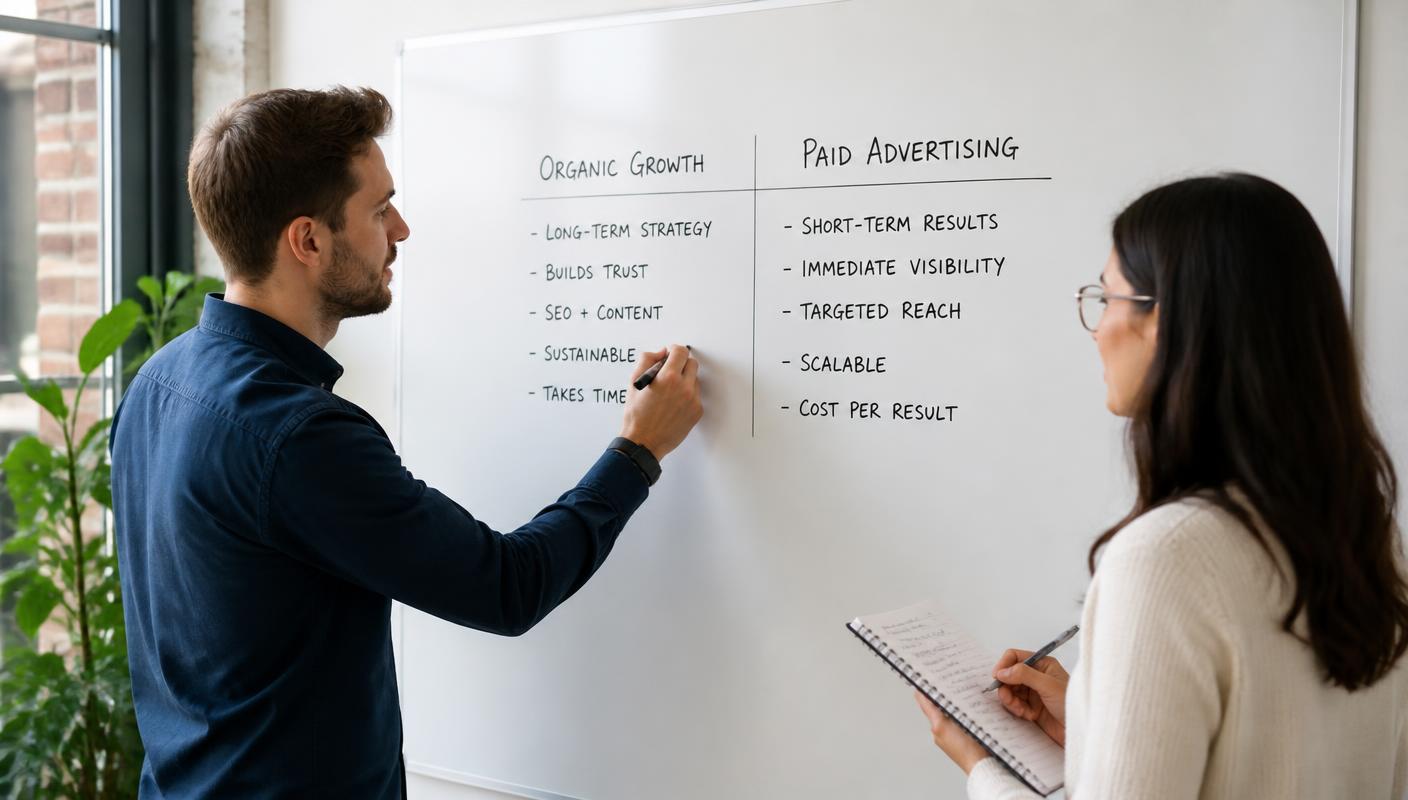
SEO builds organic visibility over time. You do not buy it per click, you accumulate it through technical work, useful pages and authority. It is slower at the start and tends to become more profitable later. The starting point is SEO for businesses in Portugal.
5. Local SEO where relevant
If you serve customers in a specific area, local results usually deliver the best return. A complete business profile, pages per service and per area, consistent contact details and genuine reviews all matter.
6. Google Ads and other advertising
Advertising buys immediate visibility for relevant searches. It is useful to validate demand, for launches and for busy commercial periods. When the budget stops, the traffic stops too. The full comparison is in Google Ads or SEO.
| SEO | Google Ads | |
|---|---|---|
| Speed | Gradual results | Immediate visibility |
| Cost | Ongoing investment in work | Cost per click |
| Duration | Compounds over time | Ends with the budget |
| Best for | Stable, recurring demand | Tests, campaigns and seasonality |
7. Landing pages
Sending paid traffic to the homepage wastes budget. A dedicated landing page answers one specific search, shows the relevant proof and proposes a single action. It is one of the fastest improvements in any campaign.
8. A clear conversion path
On every page the visitor should know the next step. A service page ends in a quote request. An article ends in a related resource or a diagnosis. A catalogue ends in a consultation. Without that chain, people read and leave.
9. Calls to action that help
- One primary action per page, visible without deep scrolling.
- Concrete wording: request a quote, book a visit, scan my website.
- A low commitment alternative for people who are not ready.
- Direct contact accessible on mobile, including call and message.
10. Forms and requests
Long forms push people away. Ask for the essentials and collect the rest in the following conversation. Always confirm the submission with a clear message and an automatic email, so the customer knows the request arrived.
11. Trust signals
Previous work, concrete cases, verifiable testimonials, complete legal information and a real address all reduce hesitation. Trust is often the factor that separates an enquiry from an exit.
12. Mobile experience
Most local search visits arrive on a phone. Small buttons, awkward forms and confusing menus cost enquiries every day. The site should be designed for the small screen first.
13. Speed
Every second of waiting reduces the chance of contact, especially on mobile connections. Heavy images and excessive code are the usual culprits.
14. Measurement
Without measurement, optimisation is guesswork. You need to know how many people arrive, where they come from, which pages generate enquiries and which campaigns produce customers rather than clicks.
15. Continuous optimisation
A commercial channel improves in iterations: adjust titles, rewrite weak pages, create missing ones, fix the steps where people drop out and reinforce what already works. It is regular work, not a one off project.
Back to the Porto example
- 1Split the single page into service pages, each with its own intent.
- 2Add local relevance for the areas actually served.
- 3Fix speed and mobile experience.
- 4Build a landing page for the campaign on the highest margin service.
- 5Put one clear primary action on every page.
- 6Measure enquiries, not just visits.
- 7Review monthly and improve what the data shows.
None of these steps is spectacular on its own. Together they turn a passive site into a channel that produces enquiries predictably.
The visitor journey in four stages
Almost no visitor decides on the first visit. Understanding which stage each person is in avoids demanding a decision from someone who is still comparing, and avoids explaining the basics to someone ready to buy.
- 1Discovery: the person has a problem and wants to understand the options. Guides and articles work here.
- 2Comparison: they know what they need and evaluate providers. Service pages, real cases and clear pricing work here.
- 3Decision: they want to move. Quote requests, direct contact and proof of credibility work here.
- 4After the sale: they are a client. Follow-up works here, and it generates referrals and new projects.
A site with only decision-stage content loses everyone still studying the subject. A site with only articles educates the market and leaves the request to a competitor.
Common mistakes that block conversion
- Talking about the company instead of the client's problem.
- Hiding prices or investment ranges without offering any reference point.
- Using the same generic call to action on every page.
- Long forms asking for information that only matters later.
- Not answering requests quickly, which cancels out every previous investment.
- Having no dedicated pages for the services with the highest margin.
What happens after the request
Conversion does not end at the form. The speed and clarity of the reply directly influence the close rate. A request answered the same day, with concrete questions and a defined next step, converts far above a generic reply sent days later.
Numbers worth reviewing every month
| Metric | What it reveals |
|---|---|
| Visits per channel | Where demand actually comes from |
| Requests received | Whether the site generates business and not only visits |
| Conversion rate per page | Which pages work and which need fixing |
| Cost per request in campaigns | Whether advertising is profitable |
| Requests that become clients | Whether the traffic attracted is the right one |
Frequently asked questions
How long before a website starts generating enquiries?
With advertising it can happen within days, provided the landing page is ready. With organic work it is measured in months and depends on competition, site quality and consistency.
Do I need to rebuild my website to improve results?
Not always. Often the biggest gain sits in structure, content, speed and conversion. A website scan shows what is worth fixing before considering a replacement.
Does it make sense to run SEO and Google Ads together?
Yes, and it is the most common scenario. Advertising delivers immediate visibility and data on what converts. SEO builds the base that reduces dependence on budget over time.
How do I know if my website converts well?
Compare enquiries against relevant visits and look at where people drop out. Without proper measurement, any assessment is opinion.
About the author
Sylvain
Founder, WebCastelo
Sylvain is the founder of WebCastelo and works every day on websites, online stores, booking systems, custom software, SEO and digital advertising for companies in Portugal and the rest of Europe. He writes about what he sees in real projects: what works, what costs money without a return and what is worth doing first.